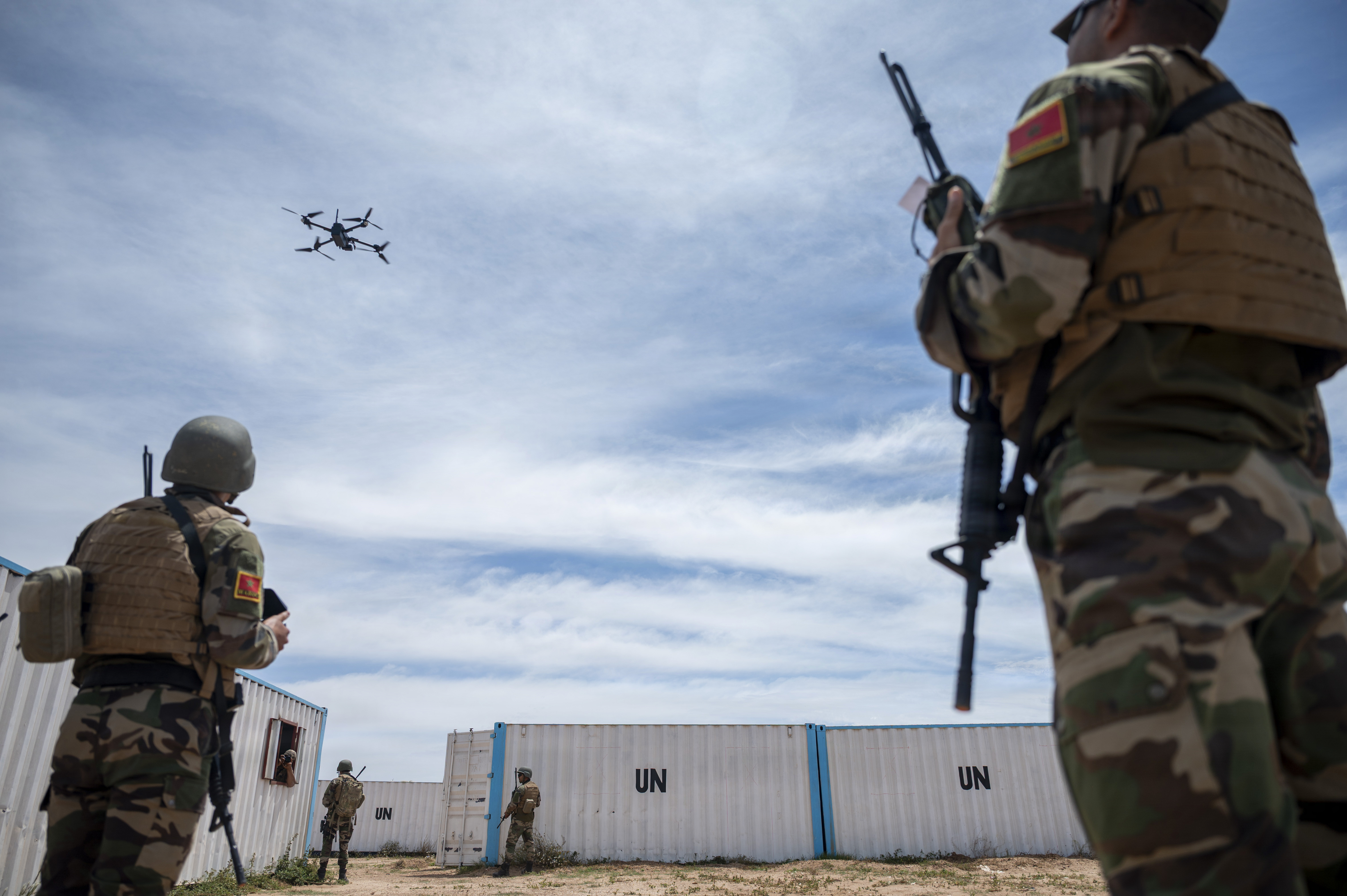
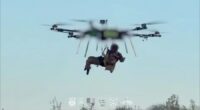
Members of the Moroccan Groupement des Forces Spéciale set up a drone to conduct reconnaissance during a Joint Combined Exchange Training (JCET) at Tifnit Training Base, Morocco, May 13, 2026. JCETs strengthen interoperability and hone crucial skills by integrating U.S. and partner forces in realistic training scenarios. (U.S. Air Force photo by Staff Sgt. Enrique Barcelo)
Members of the Moroccan Groupement des Forces Spéciale set up a drone. Photo: Staff Sgt. Enrique Barcelo/US Air Force

The US Army has announced it will evaluate up to 15 counter-unmanned aerial systems (C-UAS) in Morocco in 2027 as part of an accelerated effort to deliver proven counter-drone technology to soldiers within 180 days.

The initiative will bring together the army’s Southern European Task Force – Africa (SETAF-AF) and Global Tactical Edge Acquisition Directorate (G-TEAD) to address urgent gaps in protecting forward command posts and operating locations.

Soldier-led demonstrations are scheduled for February and March 2027 at Tan-Tan, southwestern Morocco, followed by operational assessments in April and May during African Lion 2027.

Optimizing C-UAS Distribution

The US Army plans to evaluate solutions across five capability areas: integrated mobile counter-drone kits, small drone detection, kinetic defeat, nonkinetic defeat, and passive protection.

Officials said Africa’s uncongested airspace, open electromagnetic spectrum, and varied terrain provide testing conditions that are difficult to replicate at training ranges in the US and Europe.

The trials will allow soldiers to assess systems in operationally relevant environments before the army considers scaling successful solutions across the service.

Col. Christopher Hill, director of G-TEAD, said army service component commands have historically faced capability gaps without the acquisition authority and research, development, test, and evaluation funding needed to address them.

“Soldiers need capability. We have to come in, and we have to actually perform and produce,” he added.

Following the tests, G-TEAD will present its findings to commanders, who will retain final authority over equipment selection based on the results.
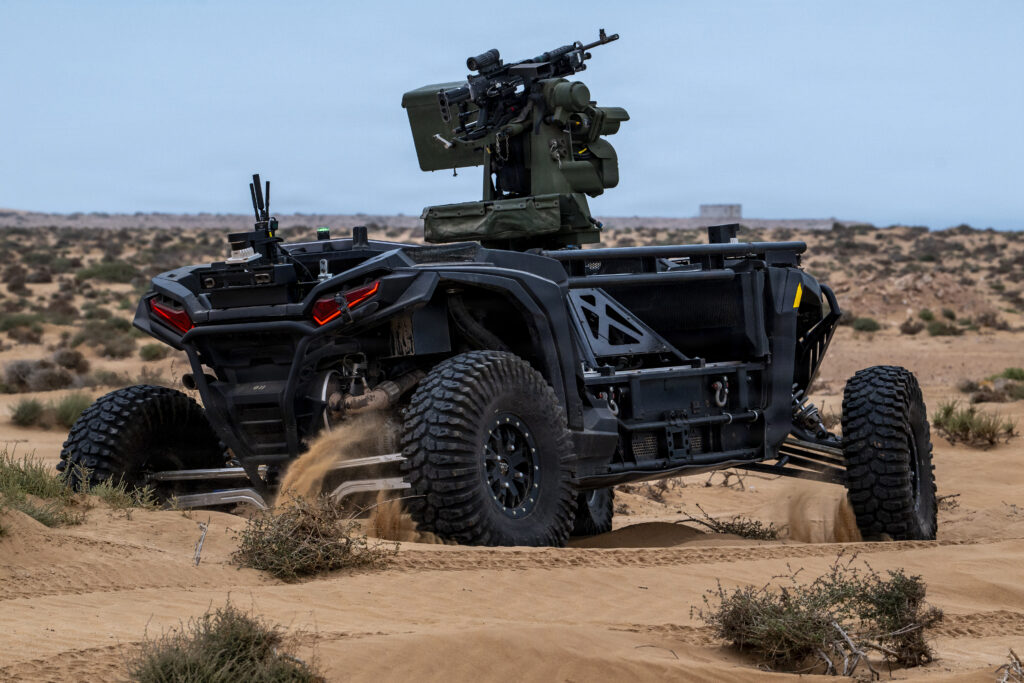
An autonomous tactical vehicle navigates a plotted course during African Lion 26 at Cap Draa, Tan-Tan, Morocco, April 26, 2026. The exercise served as a multidomain training and experimentation center - Morocco, where service members tested artificial intelligence-powered and autonomous platforms, remote systems, and emerging technologies across attack, defense and mission command operations. The experimentation accelerated target detection, shortened decision timelines and delivered cost-effective warfighting solutions aligned with African partner priorities.

AL26 is U.S. Africa Command's largest annual joint exercise, designed to strengthen collective security capabilities of the U.S., African nations and global allies. Led by U.S. Army Southern European Task Force, Africa (SETAF-AF) from April 20 to May 8, 2026, and hosted in Ghana, Morocco, Senegal and Tunisia, AL26 involves over 5,600 civilian and military personnel from more than 40 nations, using innovation to drive partner-led regional security. (U.S. Navy photo by Mass Communication Specialist 2nd Class Samuel Wagner)
An unmanned ground vehicle navigates a plotted course during African Lion in Tan-Tan, Morocco. Photo: Mass Communication Specialist 2nd Class Samuel Wagner/US Navy
You May Also Like

Panama Receives K1000ULE Long-Endurance UAS From Kraus Hamdani

The systems are expected to bolster Panama’s ISR capabilities for drug interdiction and other transnational security missions.

Fortem to Provide Net-Based Counter-Drone Shield for 2026 FIFA World Cup

Net-equipped interceptors will secure US stadiums from airborne drone threats.

General Cherry Adds French AI Guidance System to ‘Bullet’ Interceptor Drone

General Cherry’s Bullet interceptor drone is gaining a multi-sensor targeting and C2 system designed to track and engage threats without GPS.

Canadian Drone Makers Seek Foreign Sites for EW Tests as Ottawa Bars Jamming

Restrictions on radio jammers complicate Canadian firms’ efforts to validate drones against battlefield electronic warfare.