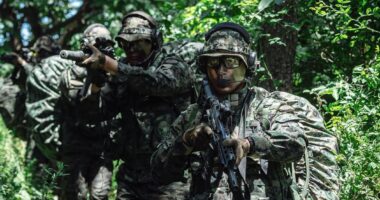
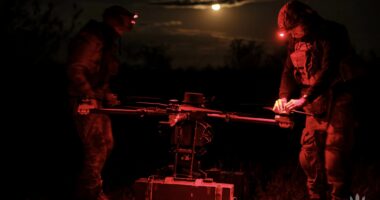
The Canadian Army has launched a pilot competition to develop small unmanned aerial systems (UAS) for indirect fire missions.
Dubbed “True North Precision,” the challenge will provide up to 2.1 million Canadian dollars ($1.5 million) in funding for affordable drones capable of laser ranging, target cueing, and impact adjustment.
The effort is intended to improve situational awareness, force protection, and operational resilience while advancing domestically developed autonomous aircraft.
The announcement follows a series of industry consultations held between December 2025 and March 2026 to define operational requirements for general-purpose drone platforms.
First Under MINERVA
Canada’s defense agency said True North Precision marks the inaugural phase of the broader MINERVA initiative, which brings together military operators, government agencies, and industry partners to build and evaluate emerging UAS technologies while strengthening sovereign capabilities.
The program is supported by Ottawa’s Bureau of Research, Engineering and Advanced Leadership in Innovation and Science (BOREALIS) and funded by the Innovation for Defence Excellence and Security (IDEaS).
Lt. Gen. Michael Wright, commander of the Canadian Army, said MINERVA will accelerate the delivery of “high-impact” assets while giving soldiers a direct role in the development and testing process.
“We are investing in innovation that will redefine operational effectiveness and safeguard our soldiers on tomorrow’s battlefields,” the chief stated.
Canadian Defence Minister David McGuinty added that the initiative reflects the government’s effort to equip troops with “cutting-edge” solutions with “real results in the field.”
“By harnessing Canadian innovation and strengthening partnerships across sectors, we are developing smarter tools that enhance decision-making and support our soldiers where it matters most,” McGuinty stressed.