U.S. Marine Corps Lance Cpl. Isaiah Trujillo, an unmanned aircraft system (UAS) maintenance technician with Marine Unmanned Aerial Vehicle Squadron (VMU) 3, Marine Aircraft Group (MAG) 24, 1st Marine Aircraft Wing (MAW), and Lance Cpl. Mario Mendoza, a UAS maintenance technician with VMU-1, MAG-13, 3rd MAW, recover a U.S. Marine Corps RQ-21A Blackjack aircraft during Weapons and Tactics Instructor (WTI) course 1-20 at Canon Air Defense Complex in Yuma, Arizona, Sept. 26, 2019. WTI is a seven week training event hosted by Marine Aviation Weapons and Tactics Squadron One (MAWTS-1), which emphasizes operational integration of the six functions of Marine Corps Aviation in support of a Marine Air Ground Task Force. WTI also provides standardized advanced tactical training and certification of unit instructor qualifications to support Marine Aviation training and readiness, and assists in developing and employing aviation weapons and tactics. (U.S. Marine Corps photo by Cpl. Adaezia Chavez)
Troops recover an RQ-21A Blackjack (Integrator) unmanned aerial system. Photo: Cpl. Adaezia Chavez/US Marine Corps

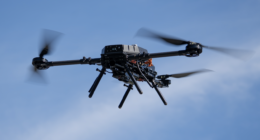
Rocket One has secured a 12-month evaluation license with the US Air Force to test a solution to physically capture and neutralize hostile unmanned aerial systems (UAS).

The agreement covers US Patent No. 10,239,637 B2, which details a system using a friendly drone capable of deploying a containment unit around an airborne threat.

The platform uses radio-frequency shielding to sever links between the target and its operator while sustaining localized jamming, spoofing, and signal-intelligence operations.

Rocket One will evaluate the concept alongside its Swarm Stage AI, a counter-UAS training technology built for scalable drone swarming simulations, to assess its performance for protecting military bases, airports, borders, and critical infrastructure.

The license grants evaluation rights only and does not allow commercial sales, serve as a procurement award, or constitute a military endorsement.

The New Jersey-based firm will assess system configurations and integration requirements during the 12-month window before seeking further commercialization approvals.

“Physical capture combined with communications isolation gives us a distinct capability to evaluate alongside Swarm Stage AI,” said Robb Knie, CEO of Rocket One. 

“Our focus is assessing how this technology could support protection of military installations, airports, borders, and critical infrastructure.”

You May Also Like

PDW Lands $820M Pentagon Backing to Scale Drone Component Production

Combined with private capital, the funding will support increased production of drone propulsion systems, power controls, and vision technology.

US to Launch Drone Training at Exercise African Lion 2026

The US Army will introduce unmanned aerial system (UAS) training during the African…

Pentagon Opens New Sprint to Field Air Defense Drone Boats

The SWAP-USV initiative offers up to $40 million in awards at this stage. It seeks mature autonomous vessels equipped with hard-kill weapons, sensors, and interoperable control systems to counter low-cost drones and helicopters.

US Army Taps Rheinmetall to Build Hybrid Logistics UGVs

The effort will produce robotic platforms capable of transporting cargo to forward troops, reducing soldiers’ exposure to enemy fire and other battlefield hazards during logistics operations.