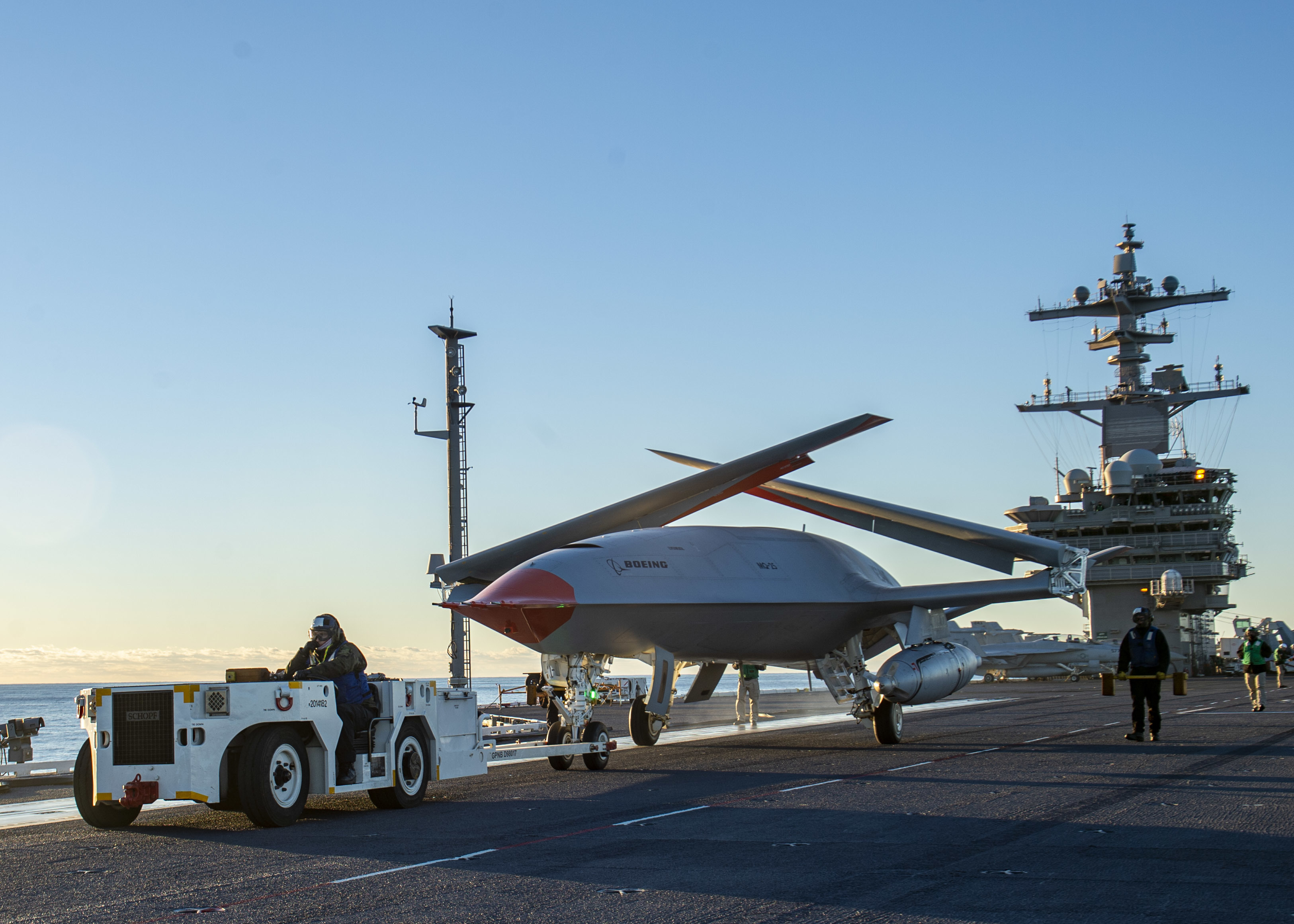
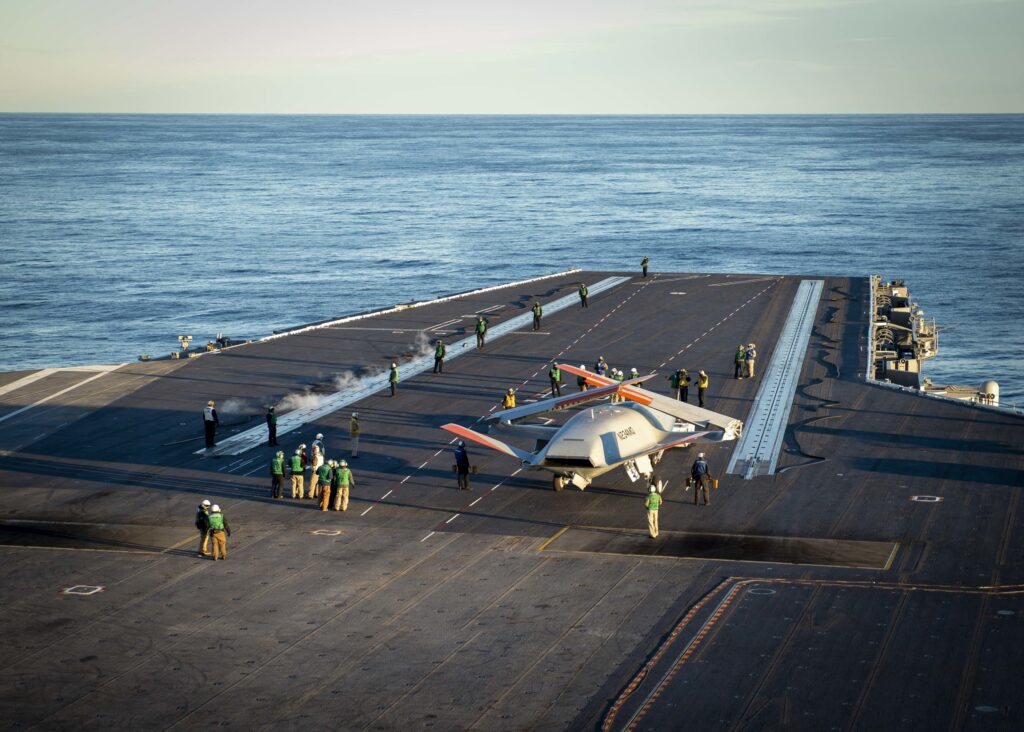
A Boeing unmanned MQ-25 aircraft is given operating directions on the flight deck aboard the aircraft carrier USS George H.W. Bush (CVN 77). The MQ-25 will be the world’s first operational, carrier-based unmanned aircraft and is integral to the Air Wing of the Future Family of Systems (AWotF FoS). Its initial operating capability (IOC) as an aerial refueling tanker will extend the range, operational capability and power projection of the carrier air wing (CVW) and carrier strike group (CSG). GHWB is operating in the Atlantic Ocean in support of naval operations to maintain maritime stability and security in order to ensure access, deter aggression and defend U.S., allied and partner interests. (U.S. Navy photo by Mass Communication Specialist 3rd Class Brandon Roberson)
An MQ-25 Stingray aboard an aircraft carrier. Photo: Mass Communication Specialist 3rd Class Brandon Roberson/US Navy

The US Navy has doubled its capacity to command the MQ-25A Stingray aerial refueling drone after installing a second operational control hub aboard the Nimitz-class aircraft carrier USS Ronald Reagan (CVN 76).

The deployment of the MD-5C ground station follows the fielding of the first unit aboard the vessel’s sister ship, USS Theodore Roosevelt (CVN 71), in March.

Both systems are housed inside dedicated Unmanned Air Warfare Centers on the carriers and powered by MDCX autonomy software from Lockheed Martin’s Skunk Works.
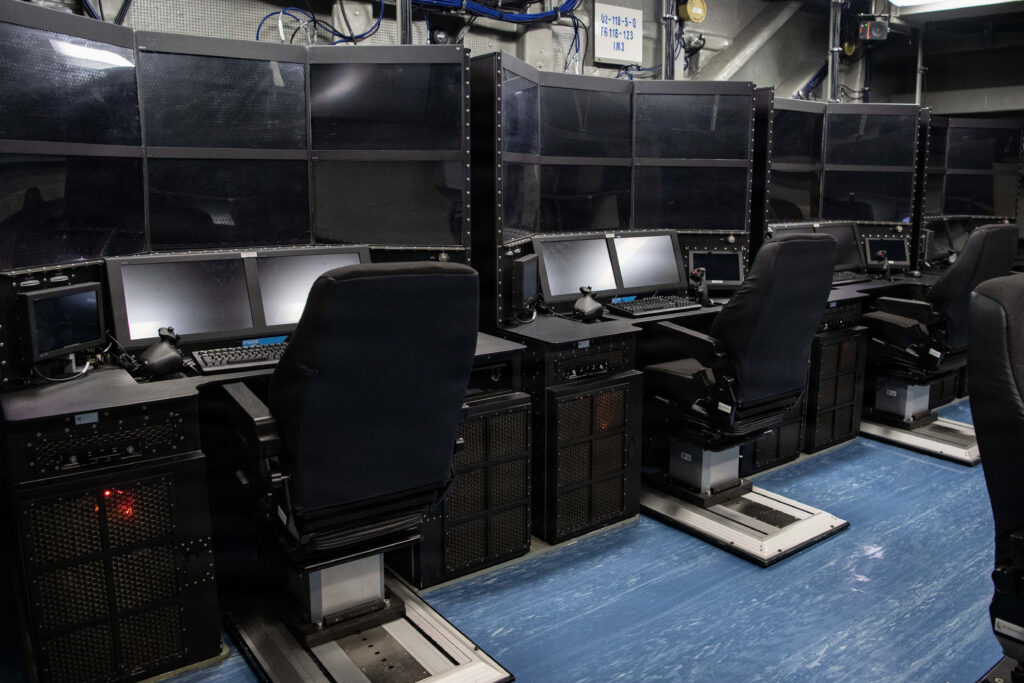
The USS Ronald Reagan (CVN 76)’s new Unmanned Air Warfare Center houses the Navy’s MD-5C Ground Control Stations that will command and control the MQ-25A Stingray unmanned aerial refueler and future unmanned carrier aircraft. (U.S. Navy photo)
The USS Ronald Reagan (CVN 76)’s new Unmanned Air Warfare Center houses the Navy’s MD-5C Ground Control Stations that will command and control the MQ-25A Stingray unmanned aerial refueler. Photo: Petty Officer 3rd Class Dylan O’Neal/US Navy

MDCX handles mission planning and execution, allowing sailors to remotely control the MQ-25A at sea and extend the carrier air wing’s strike range while freeing manned aircraft such as the F/A-18 Super Hornet for combat missions.

“These two operational unmanned air warfare centers … bring us closer to integrating unmanned carrier aviation into the fleet,” said Capt. Daniel Fucito, program manager of the PMA-268 program office in the US Navy.

“By pairing our unmanned systems with our manned aircraft, we are building a more resilient, adaptable force that is better prepared to win the fight.”

Support Contract

Before the second MD-5C was installed, the US Department of Defense awarded Lockheed a $57.7-million contract to continue software development, testing, and field support for MDCX through September 2027.

“MDCX is delivering on the promise of a ready-now, open-architecture command and control platform for the fleet,” said Ben Tongue, program manager of MDCX at Lockheed Martin.

“In five months, we’ve doubled the number of US Navy carriers ready to fly the MQ-25A Stingray.”
A Boeing unmanned MQ-25 aircraft is given operating directions on the flight deck aboard the aircraft carrier USS George H.W. Bush (CVN 77). The MQ-25 will be the world’s first operational, carrier-based unmanned aircraft and is integral to the Air Wing of the Future Family of Systems (AWotF FoS). Its initial operating capability (IOC) as an aerial refueling tanker will extend the range, operational capability and power projection of the carrier air wing (CVW) and carrier strike group (CSG). GHWB is operating in the Atlantic Ocean in support of naval operations to maintain maritime stability and security in order to ensure access, deter aggression and defend U.S., allied and partner interests. (U.S. Navy photo by Mass Communication Specialist 3rd Class Hillary Becke)
An MQ-25 Stingray aboard an aircraft carrier. Photo: Mass Communication Specialist 3rd Class Hillary Becke/US Navy
You May Also Like

Tekever Wins $536M British Army Deal for AR5 Spy Drones

Tekever AR5 brings long-endurance surveillance, real-time imagery, and beyond-line-of-sight communications to British Army operations.

Australian Kamikaze Drone Armed With Shotgun Approved for Pentagon’s Buy List

The move allows American military and federal agencies to rapidly acquire the Australian firm’s platform without policy exceptions.

New German Tech Lets Drones Operate Directly From USVs

Launch-and-recovery system developed by FLANQ and CiS enables drones to operate from uncrewed surface vessels, expanding maritime ISR and supporting NATO interoperability.

Germany Begins Mass Production of 5,000-Plus Strike Drones for Ukraine

The effort covers the Seth X medium-range drone for swarm operations and the Anubis long-range strike drone.