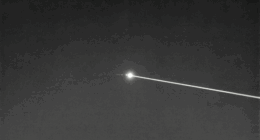

Joint Interagency Task Force 401 (JIATF-401) and the US Federal Aviation Administration (FAA) have conducted a high-energy laser test for counter-drone missions.
This collaboration between the US Department of Defense and the FAA aims to evaluate the integration of counter-unmanned aerial systems into US airspace while prioritizing the safety of civil aviation operations.
During the test at the US Army’s White Sands Missile Range in New Mexico, researchers collected data on how high-energy laser beams affect test targets designed to replicate aircraft structures.
The team also evaluated automated safety mechanisms designed to shut down the system if operating conditions become unsafe.
Additional measurements were taken to assess potential visual hazards to pilots and aircrew.
According to officials, the event continues a long series of directed-energy experiments conducted by the US military over several decades.
Data collected from previous tests has been used to refine system performance and support coordination with civil aviation authorities.
“This is a critical step in making sure our warfighters have the most advanced tools to defend the homeland,” said US Army Brigadier General Matt Ross, Director of JIATF-401.
“We are ensuring that these cutting-edge capabilities are safe, effective, and ready to protect Americans from emerging drone threats.”
Boosting Counter-Drone Capabilities
Washington is expanding testing and deployment of military technologies designed to detect and defeat drones in operational environments.
In February, the US Army conducted a live-fire test involving an AH-64 Apache attack helicopter using a proximity-fused round developed to counter unmanned aerial systems.
During the trial, the helicopter fired the 30×113 mm XM1225 Aviation Proximity Explosive round at airborne targets at various distances, demonstrating its potential for rotary-wing counter-drone operations.
Earlier this year, Parsons Corporation announced the deployment of its DroneArmor platform to support US operations along the southern border.
The system integrates AI, machine learning, and multiple sensors within a modular architecture designed to detect, track, and defeat unauthorized drones that could threaten personnel or infrastructure.