An unmanned surface vehicle is craned aboard the Independence-variant littoral combat ship USS Canberra (LCS 30), as a part of the first embarkation of the Mine Countermeasures (MCM) mission package, April 23. The MCM mission package is an integrated suite of unmanned maritime systems and sensors which locates, identifies, and destroys mines in the littorals while increasing the ship’s standoff distance from the threat area. Littoral Combat Ships are fast, optimally-manned, mission-tailored surface combatants that operate in near-shore and open-ocean environments, winning against 21st-century coastal threats. (U.S. Navy photo by Mass Communication Specialist 1st Class Vance Hand)
An unmanned surface vehicle is craned aboard the Independence-variant littoral combat ship USS Canberra (LCS 30). Photo: Mass Communication Specialist 1st Class Vance Hand/US Navy

The Pentagon’s Defense Innovation Unit (DIU) has launched the second phase of a competition to field production-ready unmanned surface vessels (USVs) capable of detecting, identifying, and neutralizing airborne threats.

The Suitable Warfighting Adaptive Payloads (SWAP)-USV initiative offers up to $40 million in awards at this stage. It seeks mature autonomous vessels equipped with hard-kill weapons, sensors, and interoperable control systems to counter low-cost drones and helicopters.

The USVs must be capable of deployment within 120 days to address a gap in the US Navy’s air defense capabilities.

The initiative aims to provide a more cost-effective response to inexpensive aerial threats, which can be uneconomical to engage with the service’s existing weapons.

Demonstrations Next Year

According to DIU’s requirements, participating vessels must sustain a cruising speed of at least 10 knots (12 miles/19 kilometers per hour), engage targets at ranges exceeding 3 nautical miles (3 miles/6 kilometers), and achieve a minimum operational range of 200 nautical miles (230 miles/370 kilometers per hour).

Preferred loadouts include Longbow Hellfire, Joint Air-Ground Missiles, Advanced Precision Kill Weapon Systems, Stinger missiles, or high-power lasers.

DIU is expected to accept submissions through late November, with in-water testing scheduled for early 2027 at Joint Expeditionary Base Little Creek in Virginia.

Shortlisted industry partners will be required to demonstrate their integrated platforms within 30 days of selection.

Up to $200M in Follow-On Contracts

The broader SWAP-USV challenge is being conducted in collaboration with the Direct Reporting Portfolio Manager for Unmanned Systems, which was recently established to oversee unmanned systems efforts.

The initiative is planned to run for 12 months and is backed by $100 million in funding.

Beyond the current phase’s $40 million award pool, the government has allocated $200 million for potential follow-on prototype or production contracts.
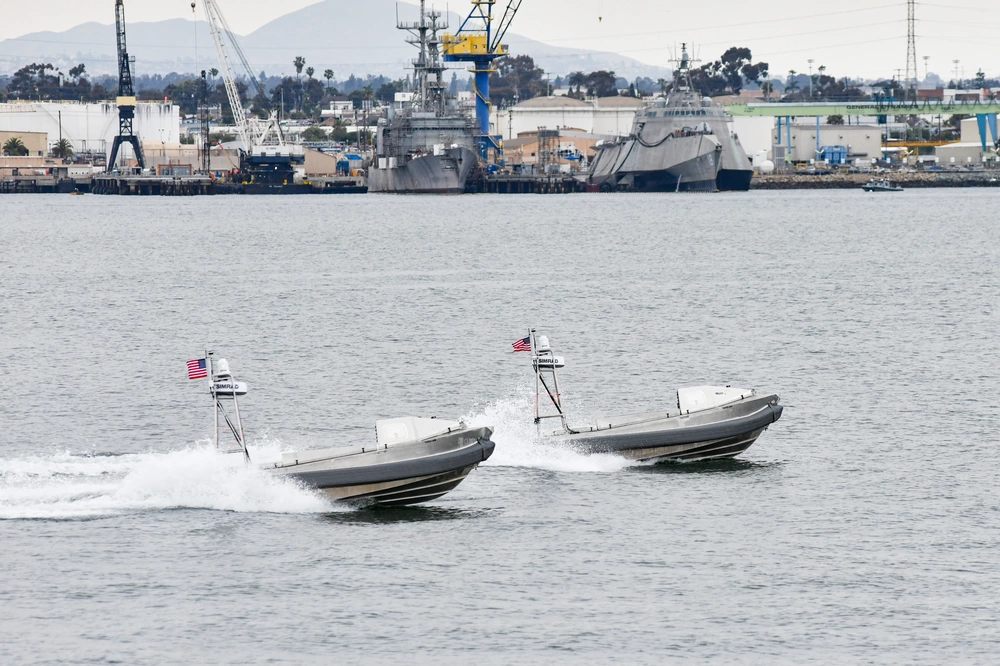
Global Autonomous Reconnaissance Craft from Unmanned Surface Vessel Squadron 3 operate remotely in San Diego Bay. Image: Mass Communication Specialist 1st Class Claire M. DuBois/US Navy
You May Also Like

British Strike Drone Completes First Warship Launch Trial

The Royal Navy launched the Nyan one-way attack drone from a warship for the first time, extending its cross-domain strike role to sea.

Ukraine Turns Ground Robots Into ‘Small Tanks’ to Hunt Covert Russian Troops

The effort centers on the company’s Buria remote weapon station, originally developed as a fixed turret system and now integrated onto robotic platforms that can maneuver toward enemy positions and engage targets.

Auterion, SkyFall to Provide Ukraine With 50,000 Strike Drones

The package combines SkyFall’s Shrike first-person view attack drones with Auterion’s Skynode S autonomy software, adding terminal guidance that allows the aircraft to engage maneuvering targets even in signal-denied environments.