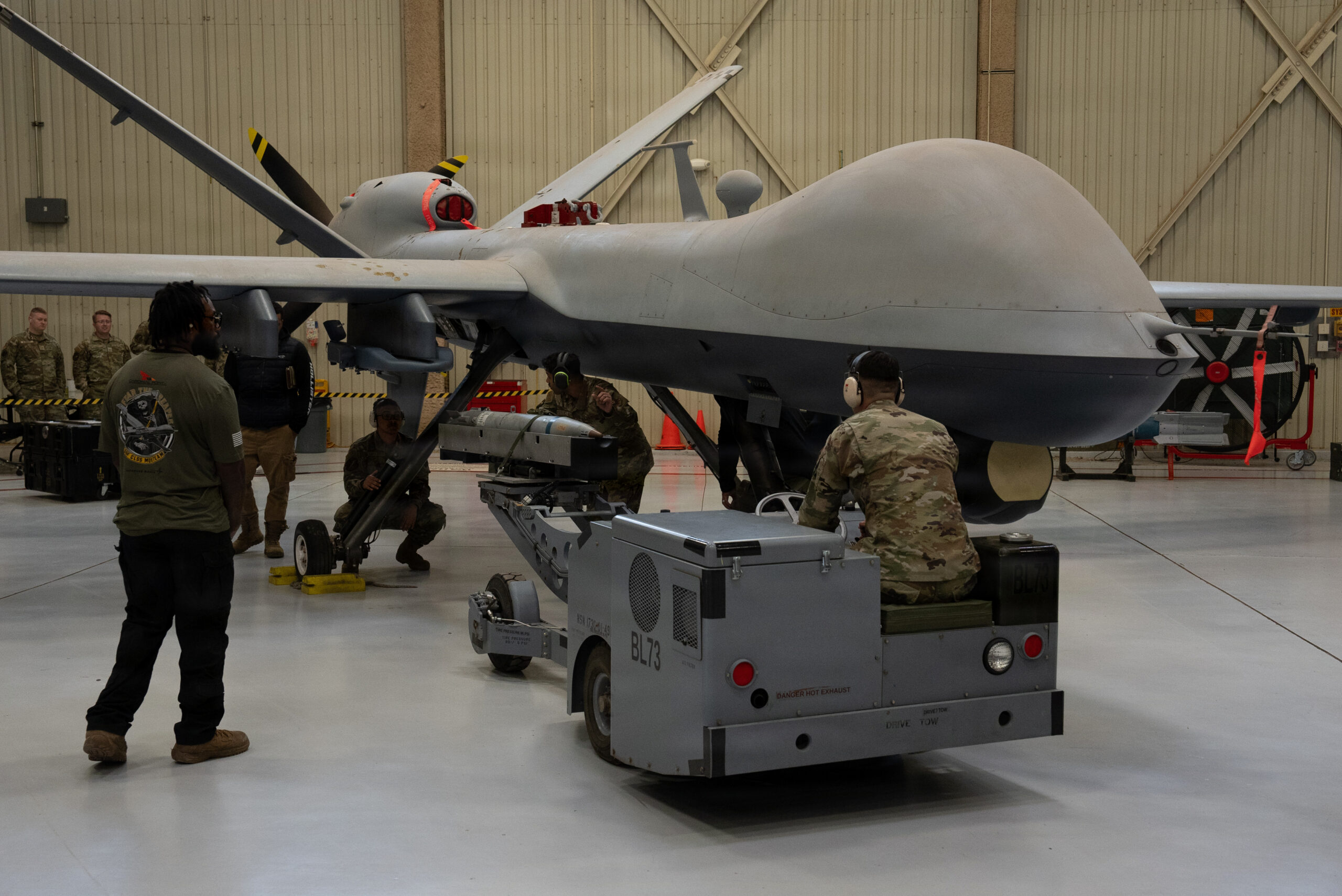

The US Air Force Special Operations Command has integrated the GBU-39B Small Diameter Bomb into MQ-9 Reaper drones, adding a long-range precision strike capability designed for contested environments.
The low-yield, precision-guided munition expands the MQ-9’s role in supporting unconventional missions while aiming to reduce collateral damage.
Drones selected for the effort are assigned to the command’s 27th Special Operations Wing (SOW) at Cannon Air Force Base, New Mexico, which handles infiltration, fire support, and replenishment tasks.
Surefire Solution
The GBU-39B is a 250-pound (133-kilogram) air-delivered weapon carrying 36 pounds (16 kilograms) of high explosive. When released at the appropriate speed and altitude, it can glide up to 60 miles (16 kilometers).
It is designed to strike within one meter (3 feet) of its target, allowing crews to engage threats while remaining outside the range of many ground-based air defense systems.
First introduced into the US Air Force service in 2006, the munition has been widely used across fighter jets, bomber aircraft, and gunships.
“In this shifting battlespace, adversaries layer lethal obstacles to deny us,” said Lt. Col. Joshua Swann, an MQ-9 squadron commander with the 27th SOW.
“The GBU-39’s reach guarantees we can stay in a fight under hostile threats and continue to solve the joint force’s hard tactical problems.”
Dual Carriage Technology
The MQ-9 carries the munition using the BRU-78 smart dual bomb rack, developed specifically for the platform, enabling it to carry multiple low-yield weapons on a single sortie.
“When striking targets, our intent is to maximize effects and minimize collateral damage,” an MQ-9 pilot assigned to the 27th SOW explained.
“Carrying a higher number of low-yield munitions allows us to stay on station longer and provide more effective support to our troops on the ground.”