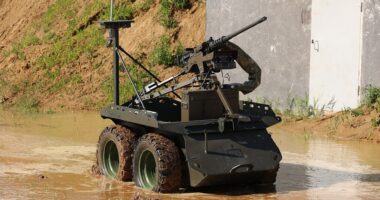
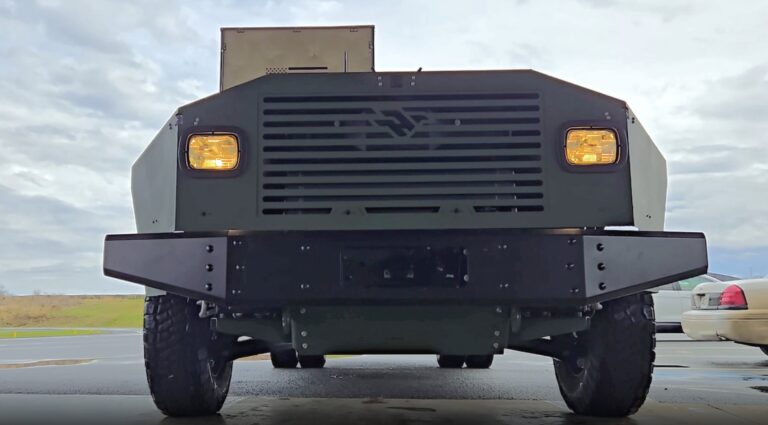
Harbinger Praesidia has unveiled a hybrid-electric unmanned ground vehicle (UGV) designed to support military logistics, communications, electronic warfare (EW), and counter-drone missions.
The platform can export up to 350 kilowatts of power, enabling it to operate radar systems, communications equipment, EW payloads, and other power-hungry battlefield assets.
Built on Harbinger’s hybrid-electric architecture, the UGV is available in three wheelbase configurations and can carry payloads of up to 18,000 pounds (8,165 kilograms).
The company said it can travel more than 500 miles (805 kilometers) in hybrid mode or 105 miles (169 kilometers) on battery power alone, reaching speeds of up to 65 miles (105 kilometers) per hour.
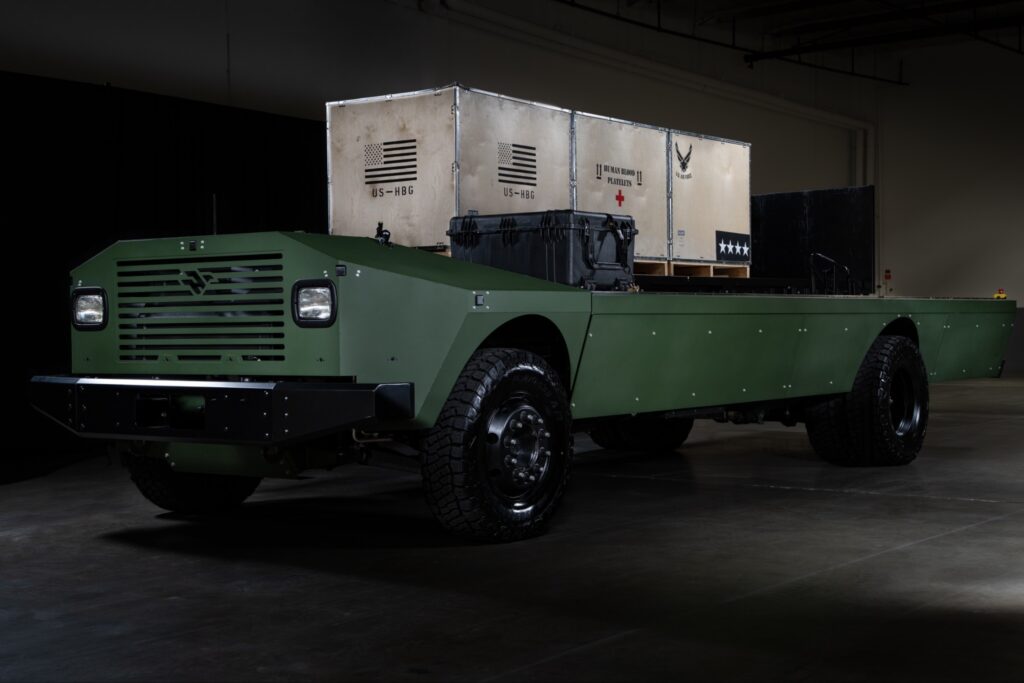
An electric drive motor is paired with a gasoline engine and onboard generator, allowing the platform to recharge its batteries while moving or supply power to external systems when stationary.
“The government needs robust vehicles that can support a wide range of use cases without forcing operators to compromise on payload, range, exportable power or durability,” said John Harris, co-founder and chief executive officer of Harbinger.
Built for Remote Operations
The UGV incorporates steer-by-wire, brake-by-wire, and accel-by-wire controls and is designed for both autonomous and remotely operated missions.
Harbinger said the platform can be fully teleoperated through its software architecture and integrated with third-party autonomy solutions.
A six-camera suite provides 360-degree situational awareness, while remote controls allow operators to deploy pallets, operate the liftgate, and export power without personnel at the vehicle.
For communications, the system combines mesh radio networks and satellite links, supporting line-of-sight control at distances of up to 5 kilometers (3.1 miles) and beyond-line-of-sight operations via satellite connectivity.
Designed for Contested Environments
The platform features a stealth mode that disables exterior lighting, acoustic warning devices, and the onboard generator to reduce its acoustic and thermal signature during sensitive missions.
It is designed to operate in temperatures ranging from -30°C (-22°F) to 55°C (131°F) and at altitudes up to 12,000 feet (3,658 meters).
The vehicle can also traverse rough terrain, steep grades, loose surfaces, standing water, snow, potholes, and deep ruts.
The unveiling coincided with a strategic investment from In-Q-Tel, the venture firm supporting emerging technologies for the US national security community and allied nations.
Harbinger also recently partnered with American Rheinmetall to develop robotic and uncrewed ground systems, expanding its footprint in autonomous military vehicles and robotic logistics platforms.