South Korea’s growing investment in unmanned ground vehicles (UGVs) may look like a push to modernize its military, but a key driver is the country’s shrinking pool of available soldiers, according to British analytics firm GlobalData.
Seoul had approximately 450,000 active-duty troops in 2025, down from around 560,000 in 2019. The decline has encouraged the country to explore robotic platforms for roles that would otherwise require additional personnel.
GlobalData projects South Korea will spend roughly $140 million on ground robotics procurement through 2036, with UGVs expected to perform missions including logistics, surveillance, and mine clearance.
“The pool of young men assessed fit for active-duty conscription fell 29 percent over the past decade,” said Tushar Mangure, aerospace and defense expert at GlobalData.
“Restructuring units or extending service terms cannot absorb a decline on that scale, which leaves substituting machines for manpower at squad level. The requirement here is arithmetic rather than doctrine.”
Robots Help Fill the Gap
Seoul is moving ahead with UGV adoption under the Republic of Korea Army’s Tiger 4.0 initiative, which aims to transform ground force capabilities by 2040.
While the effort includes a broader push toward military modernization, GlobalData argues that manpower shortages are a significant factor behind the country’s growing interest in ground robotics.
UGVs could take on missions that do not always require a human operator to be physically present, helping the military maintain capabilities despite a smaller pool of recruits.
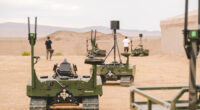
A recent example is the purchase of Hanwha’s Arion-SMET six-wheeled electric robot, scheduled for deployment between 2027 and 2028.
The acquisition follows a platform demonstration in Hawaii in late 2023 under a Pentagon testing program that evaluated tactical equipment developed by US and foreign companies.
“That evaluation carries more weight than the domestic award,” Mangure noted. “It places a Korean UGV inside a US assessment pipeline, which is the practical route to interoperability with the American forces the [Republic of Korea] would fight alongside on the peninsula.”
Hanwha’s Arion-SMET contract represents nearly one-quarter of South Korea’s projected UGV spending through 2036, making the company a significant player in the country’s growing ground robotics market.