Filipino engineers from Mindanao State University are developing a prototype of an unconventional naval platform: a “kamikaze drone” designed to look like a civilian boat.
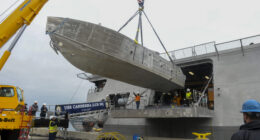
A concept model of the Philippine Autonomous Littoral Interdiction Drone (Palid) was showcased for the first time during the recent Self Reliance Defense Posture (SRDP) summit hosted by the Philippine Navy in Manila.
The unmanned surface vessel (USV) has a maximum displacement of 650 kilograms (1,433 pounds) and can reach speeds of up to 40 knots (74 kilometers/46 miles per hour).
It boasts a payload capacity of 150 kilograms (330 pounds) and is designed to be armed with an unguided bomb.
Palid can be used for one-way attack missions at sea, targeting propulsion systems or radars of larger enemy warships with the help of its optical and infrared sensors.
“If the ship’s propulsion systems or radar becomes inoperable, their ships that are worth a billion dollars would be useless,” Rembrandt Cajocon, one of the engineers involved in the project, told Inquirer.net.
The initiative is funded by the Philippines’ Department of Economy, Planning, and Development, with a full-scale prototype expected within two years.
‘Virtually Indistinguishable’ From Civilian Boat
Drone boats are playing an increasingly critical role in modern warfare, offering low-cost, high-impact options for asymmetric naval operations.
They allow naval forces to maintain presence in contested waters without risking crewed vessels or high-value military assets.
Palid embodies this idea by presenting itself as a “civilian boat,” hiding its offensive arsenal from potentially hostile ships.
“This is a suicide drone, but it also disguises itself like a civilian boat,” Cajocon stated. “If one sees this, one might think it’s just a normal boat.”
The disguise helps operators get close to larger enemy warships, giving it favorable positions for precision strikes.
While the USV holds up to 120 liters (31.7 gallons) of gasoline, it can run on an empty tank for 48 hours through its internal batteries.
Cajocon said Palid can also serve as a surveillance platform, with a Starlink system onboard to provide “unlimited” communication range.
Eyes on China
Palid is part of the navy’s broader push to locally develop unmanned technologies for maritime defense.
“If you see the exhibit, it’s more about drones, because that is the thrust right now of the Philippine Navy,” said Philippine Navy Captain Gregory Fabic.
Department of National Defense Assistant Secretary Augusto Gaite also noted the importance of investing in unconventional warfare, citing tensions with China as a key reason the Philippines must prepare for more flexible, tech-driven conflict scenarios.
“We cannot go conventional with, let’s say, for example, China,” he stated. “But what would give us an edge for, let’s say, confrontation would be something like asymmetric [capabilities].”