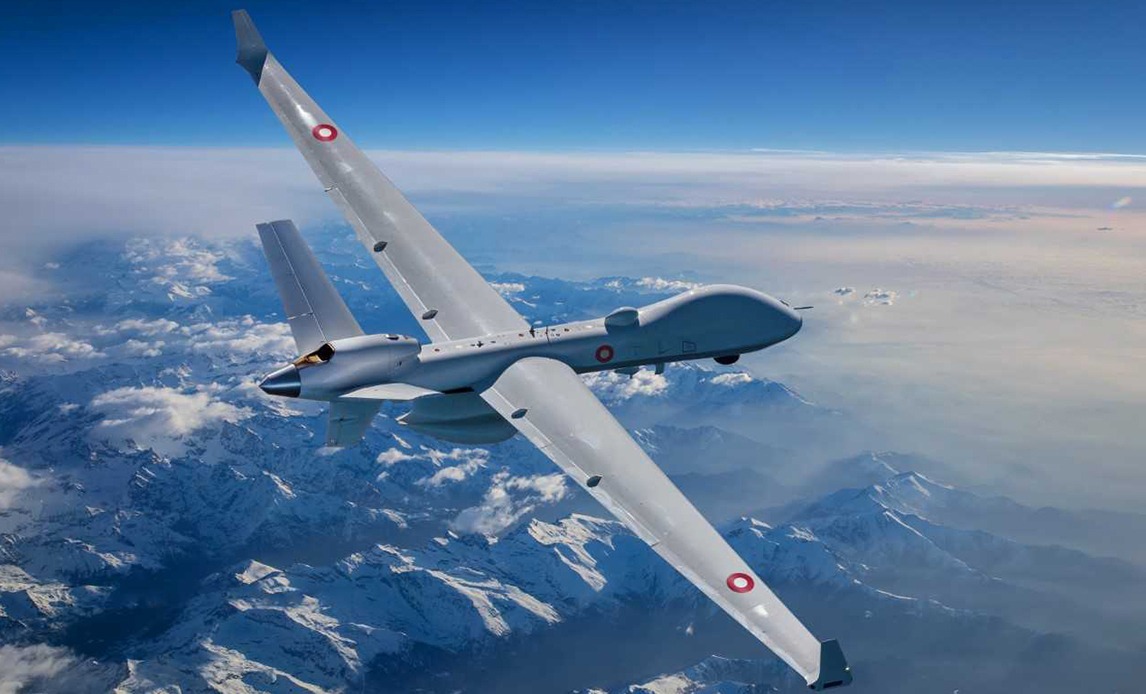
The Royal Danish Air Force has established a new squadron to enhance surveillance operations across the Arctic and Greenland, which will be equipped with four MQ-9B SeaGuardian unmanned aerial systems.
Denmark procured four MQ-9Bs in July 2025 through the NATO Support and Procurement Agency, with deliveries expected in 2028.
The 729 Squadron will be assigned to the Air Transport Wing and operate from Aalborg Air Base. According to the Danish Broadcasting Corporation, the unit will be staffed by just over 100 personnel, with the first crews appointed this year before attending training courses in the US.
Reactivated Squadron
An earlier incarnation of 729 Squadron served from 1955 to 1993 as a photo-reconnaissance unit, undertaking missions that included intelligence support during the Cuban Missile Crisis.
Beyond intelligence, surveillance, and reconnaissance, the reactivated squadron is also expected to support environmental monitoring and search-and-rescue missions.
“The squadron and the new aircraft, with the designation MQ-9B SeaGuardian, is a part of the Danish Defence’s ongoing build up,” the air force stated in a press release.
“It is Denmark’s ambition to expand the monitoring and surveillance in the Arctic and Greenland and 729 Squadron and the new long-range aircraft will contribute to that ambition.”
MQ-9B Sea Guardian
The MQ-9B SeaGuardian is the maritime variant of the SkyGuardian remotely piloted aircraft system, missionized through a “bolt-on/bolt-off” architecture that allows rapid integration of specialized sensors.
These include a centerline wide-area maritime radar, an automatic identification system, electronic support measures, and a self-contained anti-submarine warfare mission kit.
Designed for over-the-horizon operations via satellite control, the SeaGuardian can remain airborne for more than 30 hours, depending on configuration, operate in all weather conditions, and safely integrate into civilian airspace.
The platform measures 12 meters (39 feet) in length, features a 24-meter (78-foot) wingspan, and can operate at altitudes of up to 15,000 meters (49,213 feet).