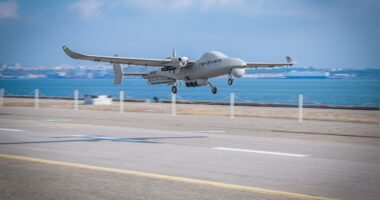
Lithuania has announced plans to use a portion of its annual aid budget for Kyiv to manufacture tactical unmanned aerial systems domestically in collaboration with Ukrainian defense companies.
Under the proposed initiative, a significant share of the funding would directly finance drone assembly lines on Lithuanian soil, combining the country’s manufacturing capacity with Ukrainian technological expertise to build systems for delivery to Kyiv’s forces.
The Baltic nation currently allocates more than 0.25 percent of its annual gross domestic product, or approximately 230 million euros ($264 million), to support the Ukrainian Armed Forces.
Reviving a Stalled Plan
Lithuanian President Gitanas Nausėda announced the strategy following a State Defense Council meeting, saying it would also strengthen the Baltic state’s domestic defense industry.
“We’ll produce them here in Lithuania. This means jobs, technological knowledge, and industrial development here,” Delfi quoted the president as saying.
“This would increase volumes, enhance economies of scale, reduce production costs, and make us more competitive in this market.”
While Vilnius and Kyiv have signed two preliminary agreements, Nausėda acknowledged that joint production has fallen behind schedule.
Although the delays were initially blamed on lengthy Ukrainian licensing procedures, Nausėda noted that domestic bottlenecks, including slow approval of participating manufacturers and small initial orders, have also hampered the production ramp-up.
He emphasized that Lithuania must commit to larger order volumes to make the industrial partnership viable.
“If we define the volume as several Maguras, a dozen or so aerial drones, then we will look ridiculous and, most likely, nothing will move forward,” Nausėda explained.
Drone Incursion, Expanding Defense Ties
The announcement comes after NATO fighters stationed in Lithuania shot down a Russian Gerbera drone that entered the country’s airspace from Belarus after reportedly being knocked off course by Ukrainian electronic warfare.
The incident highlighted growing regional security concerns and the urgent need for cost-effective, multi-layered air defense systems across the Baltic region.
Meanwhile, Lithuania continues to expand its broader defense-industrial ties with Kyiv.
In August, Ukrainian firm DEMZ signed an agreement to construct a 29-million-euro ($33.3-million) ammunition plant in Kaunas.
Vilnius also continues to fund research into domestically developed interceptor drones.