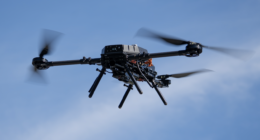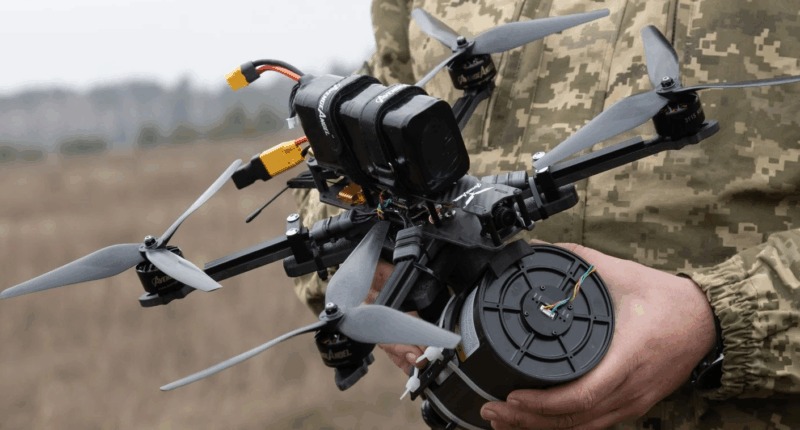

A recent audit report has found that Taiwan’s existing drone defenses are not equipped to counter fiber-optic and AI-guided systems, exposing a potential gap against more advanced Chinese unmanned platforms.
The island nation relies heavily on electronic warfare (EW), signal disruption, and jamming to defeat drones. But those defenses could be ineffective against systems that use fiber-optic links or autonomous guidance to reduce dependence on conventional radio-frequency communications.
The report also points to gaps in Taiwan’s ability to detect and counter drones operating across different frequency bands. Most drones currently in service use the 2.4 gigahertz (GHz) and 5.8 GHz bands, while China is developing systems that can operate on the 5.1 GHz band.
The National Chungshan Institute of Science and Technology (NCSIST) is reportedly developing detection capabilities for these threats, but the audit found that the systems cannot currently disrupt drones operating on 5.1 GHz.
The report also said Taiwan’s systems cannot detect certain bandwidths associated with China’s Beidou-3 satellite navigation system, potentially creating another gap in the country’s ability to track and counter Chinese drones.
Procurement problems and delays in NCSIST programs have further slowed efforts to close these gaps, with project bidding issues reportedly pushing production schedules behind target and disrupting the broader development of Taiwan’s counter-drone network.
Reworking Program Vision
NCSIST has said it will research and develop capabilities to detect drones operating on the 5.1 GHz band as part of efforts to address the shortcomings identified in the audit.
The Republic of China Air Force also assured that it will assist NCSIST with its commissioned systems and examine expanding their capabilities to cover additional frequency bands.
A Wider Counter-Drone Problem
The audit highlights a broader problem for Taiwan: defenses built around conventional radio-frequency jamming may struggle against drones designed to operate outside those parameters.
Fiber-optic drones are particularly difficult to defeat with conventional electronic warfare because their control links do not depend on radio-frequency communications.
AI-guided systems can also reduce their reliance on continuous operator control, limiting the effectiveness of countermeasures designed to disrupt the link between a drone and its operator.
The problem becomes more acute when such systems are deployed in large numbers. A single jamming system can cover only a limited area and frequency range, while using high-end EW assets against inexpensive mass-produced drones can quickly become an unfavorable exchange.
Experts have suggested Taiwan should instead build a layered counter-drone architecture combining electronic warfare with automated turrets, directed-energy weapons, mobile fire units, and surface-to-air missiles.