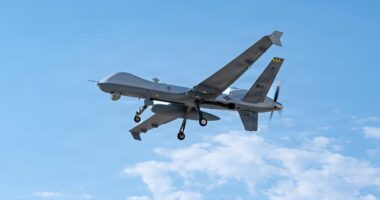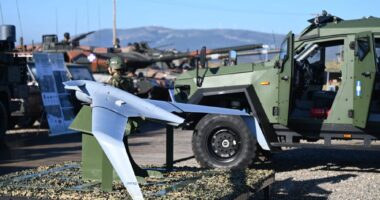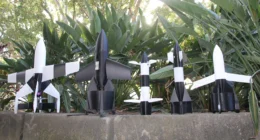
The US has partnered with Shield AI to integrate its proprietary Hivemind autonomy software into the Low-Cost Uncrewed Combat System (LUCAS) loitering munition, adding AI-enabled coordination, navigation, and swarm capabilities to the platform.
Developed for the Pentagon, LUCAS is designed to mirror the Iranian-made Shahed one-way attack platform and provide a low-cost solution that can deploy in large numbers to overwhelm enemy defenses and expand combat capacity.
Hivemind will act as the drone’s onboard autonomous pilot, enabling coordinated swarm operations in contested or signal-denied environments while requiring only a single human operator.
The AI software supports mission planning, mapping, obstacle avoidance, and in-flight route adjustments without relying on preprogrammed flight paths.
It can also adapt during missions, accelerating the timeline from detection to engagement while reducing risk to personnel on the ground.
Recent Hivemind Works
The California-based company said the selection builds on previous Hivemind deployments across the US and allied military platforms.
These include the US Air Force’s Collaborative Combat Aircraft program, which leverages Anduril’s YFQ-44A airframe, as well as the US Navy’s BQM-177 target drone development.
Other integrations include the Airbus UH-72B Lakota rotary-wing drone and the Destinus Hornet system.
“LUCAS is about delivering affordable mass, but mass without coordination is limited in value,” said Brandon Tseng, president and co-founder of Shield AI.
“Hivemind is the AI pilot that makes that mass intelligent. It’s the autonomy layer that enables teams of drones to sense, decide, and act at scale. We’re proud … to put this capability in the hands of the warfighter at the speed of relevance.”